Olfactiva 01

A&S Research & Development: Exploring the Potential of Aroma Ingredients for Human Well-Being and Health

Naturally derived molecules that interact with olfactory receptors
to trigger physiological responses via the olfactory system.

Bio-Responsive Aroma Ingredients

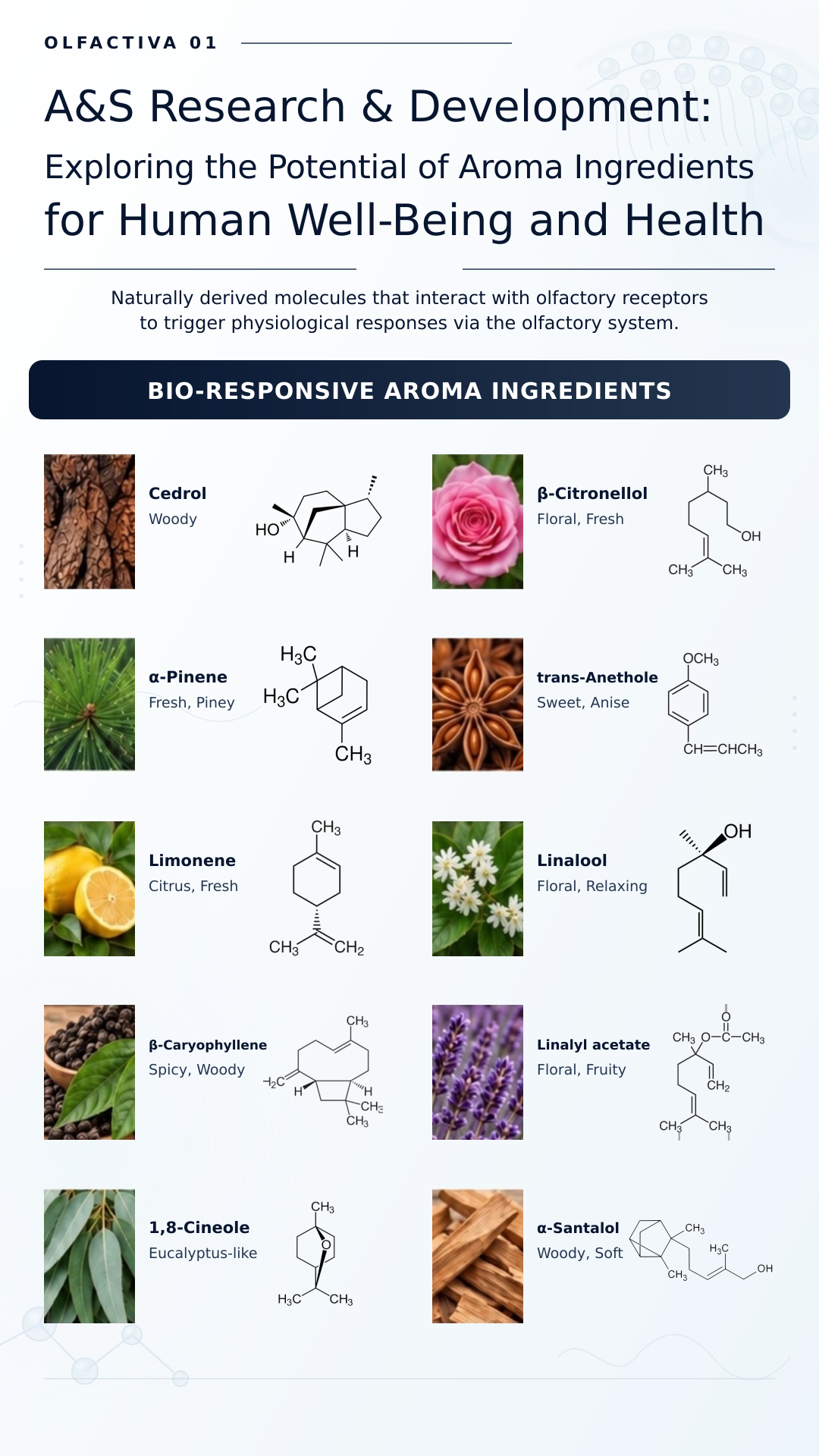
  • Cedar bark

    Cedrol

    Woody

    Chemical structure reproduced from the supplied aroma ingredient reference.
  • Pine needles

    α-Pinene

    Fresh, Piney

    Chemical structure reproduced from the supplied aroma ingredient reference.
  • Lemon and leaves

    Limonene

    Citrus, Fresh

    Chemical structure reproduced from the supplied aroma ingredient reference.
  • Peppercorns and leaves

    β-Caryophyllene

    Spicy, Woody

    Chemical structure reproduced from the supplied aroma ingredient reference.
  • Eucalyptus leaves

    1,8-Cineole

    Eucalyptus-like

    Chemical structure reproduced from the supplied aroma ingredient reference.
  • Pink rose

    β-Citronellol

    Floral, Fresh

    Chemical structure reproduced from the supplied aroma ingredient reference.
  • Star anise

    trans-Anethole

    Sweet, Anise

    Chemical structure reproduced from the supplied aroma ingredient reference.
  • White aromatic flowers

    Linalool

    Floral, Relaxing

    Chemical structure reproduced from the supplied aroma ingredient reference.
  • Lavender flowers

    Linalyl Acetate

    Floral, Fruity

    Chemical structure reproduced from the supplied aroma ingredient reference.
  • Sandalwood

    α-Santalol

    Woody, Soft

    Chemical structure reproduced from the supplied aroma ingredient reference.
Olfactiva 02

A&S OlfactivaTMExploring
Olfactory Pathways
for Well-Being

Naturally derived molecules that interact with olfactory receptors to trigger physiological responses via the olfactory system.

Two-part pathway

  1. Ingredient Profile

    Proprietary ingredient
    Bio-responsive properties

  2. Olfactory Activation

    Ingredient molecules
    Receptor interface

A&S Olfactory Science

Ingredient Pathway

01 · A&S OlfactivaTM Ingredient & Olfactory Interface

Company-Developed
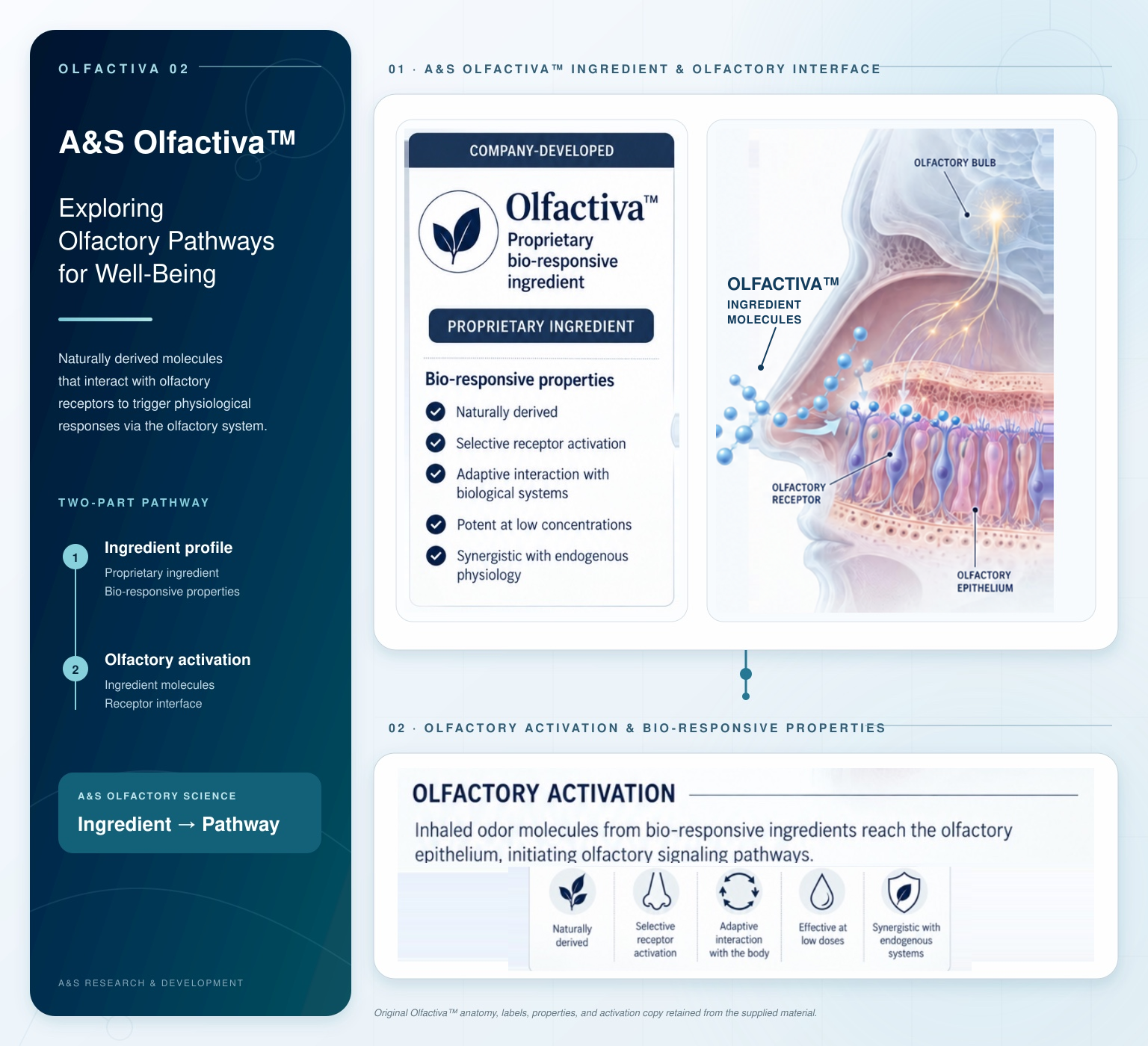
OlfactivaTM

Proprietary
bio-responsive
ingredient

Proprietary Ingredient

Bio-responsive properties
  • Naturally derived
  • Selective receptor activation
  • Adaptive interaction with biological systems
  • Potent at low concentrations
  • Synergistic with endogenous physiology
Olfactiva ingredient molecules interacting with the olfactory epithelium, receptors and olfactory bulb. Scientific annotations are retained from the supplied diagram.

02 · Olfactory Activation & Bio-Responsive Properties

Olfactory Activation

Inhaled odor molecules from bio-responsive ingredients reach the olfactory epithelium, initiating olfactory signaling pathways.

  • Naturally derived

  • Selective receptor activation

  • Adaptive interaction with the body

  • Effective at low doses

  • Synergistic with endogenous systems

Original OlfactivaTM anatomy, labels, properties, and activation copy retained from the supplied material.
Olfactiva 03

A&S OlfactivaTMfrom Olfactory
Pathways to
Brain Networks

The olfactory pathway linking OlfactivaTM ingredient molecules to sensory processing and interconnected brain networks.

Two-part pathway

  1. Olfactory Pathway

    Epithelium · Sensory neurons
    Bulb · Olfactory cortex

  2. Brain Network

    Five connected regions
    Functional processing roles

A&S Olfactory Science

Scent Brain Network

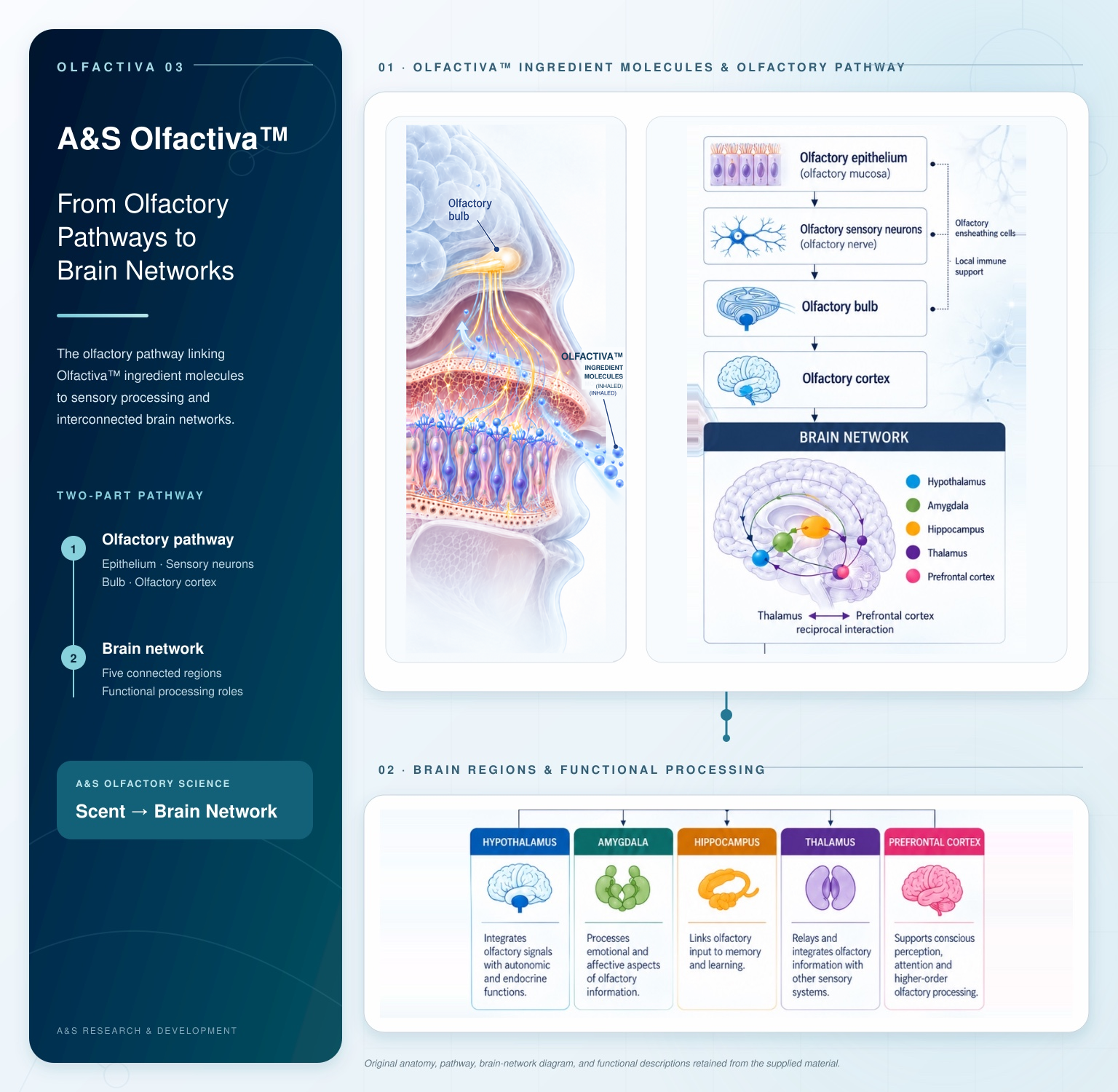
01 · OlfactivaTM Ingredient Molecules & Olfactory Pathway

Inhaled Olfactiva ingredient molecules, sensory neurons and the olfactory bulb, with original anatomical annotations.
  1. Olfactory epithelium

    (olfactory mucosa)

  2. Olfactory sensory neurons

    (olfactory nerve)

  3. Olfactory bulb

  4. Olfactory cortex

Olfactory ensheathing cells

Local immune support

Brain Network

Interconnected brain regions, shown with colored pathways.
  • Hypothalamus
  • Amygdala
  • Hippocampus
  • Thalamus
  • Prefrontal cortex

Thalamus Prefrontal cortex
reciprocal interaction

02 · Brain Regions & Functional Processing

Hypothalamus

Integrates olfactory signals with autonomic and endocrine functions.

Amygdala

Processes emotional and affective aspects of olfactory information.

Hippocampus

Links olfactory input to memory and learning.

Thalamus

Relays and integrates olfactory information with other sensory systems.

Prefrontal cortex

Supports conscious perception, attention and higher-order olfactory processing.

Original anatomy, pathway, brain-network diagram, and functional descriptions retained from the supplied material.
Olfactiva 04

A&S OlfactivaTMfrom Brain Networks
to Physiological
Responses

A systems-level view of downstream signaling and potential well-being outcomes associated with OlfactivaTM bio-responsive ingredients.

Two-part pathway

  1. Physiological Signaling

    Neurotransmitter · Nervous system
    Immune · Metabolic regulation

  2. Potential Outcomes

    Clinical relevance
    Well-being & health

A&S Olfactory Science

Network Response

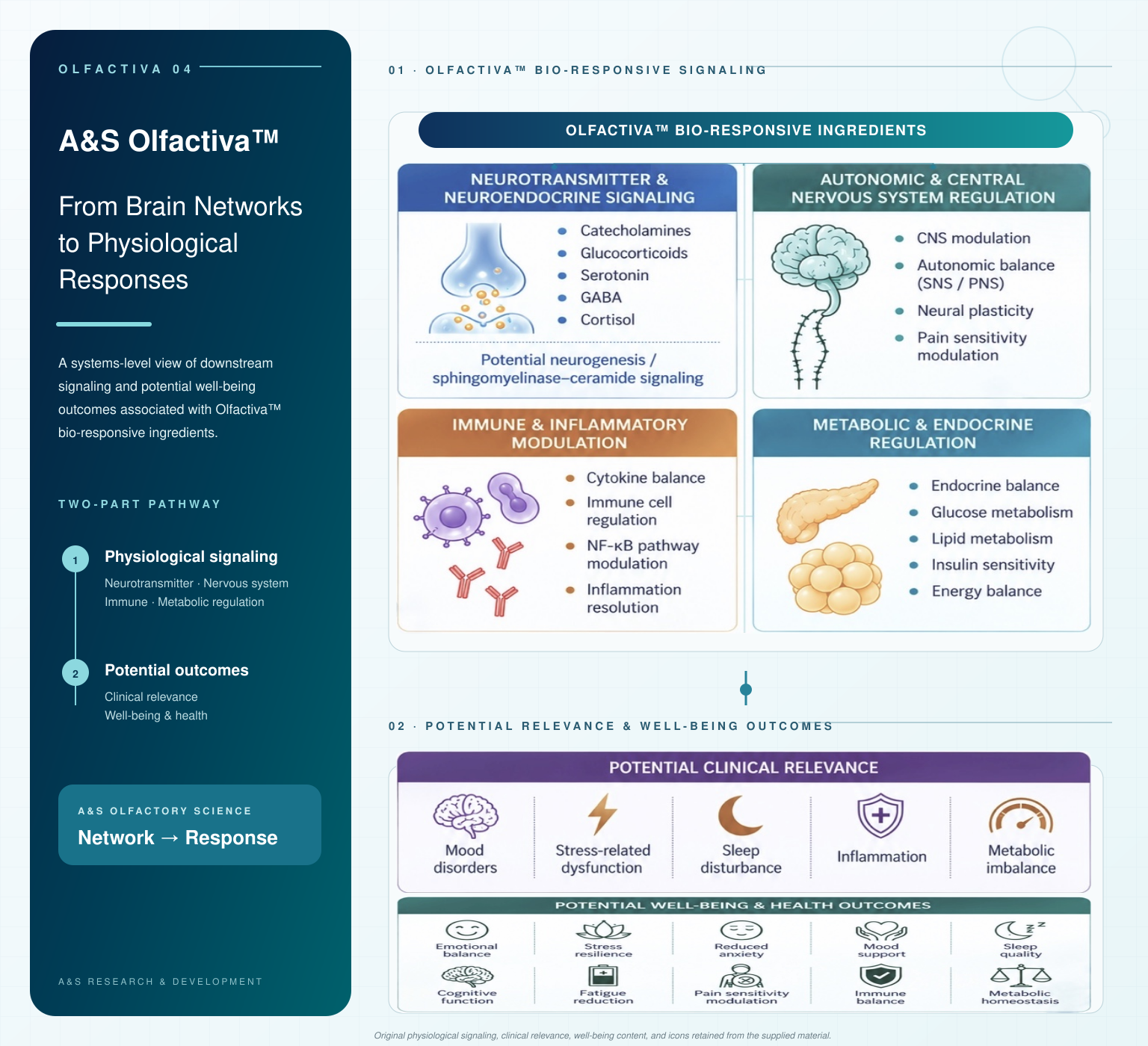
01 · OlfactivaTM Bio-Responsive Signaling

OlfactivaTM Bio-Responsive Ingredients

Neurotransmitter &
Neuroendocrine Signaling
Synaptic neurotransmitter signaling.
  • Catecholamines
  • Glucocorticoids
  • Serotonin
  • GABA
  • Cortisol

Potential neurogenesis /
sphingomyelinase-ceramide signaling

Autonomic & Central
Nervous System Regulation
Brain and spinal cord.
  • CNS modulation
  • Autonomic balance (SNS / PNS)
  • Neural plasticity
  • Pain sensitivity modulation
Immune & Inflammatory
Modulation
Immune cells and antibodies.
  • Cytokine balance
  • Immune cell regulation
  • NF-κB pathway modulation
  • Inflammation resolution
Metabolic & Endocrine
Regulation
Pancreas and adipose cells.
  • Endocrine balance
  • Glucose metabolism
  • Lipid metabolism
  • Insulin sensitivity
  • Energy balance

02 · Potential Relevance & Well-Being Outcomes

Potential Clinical Relevance

  • Mood disorders

  • Stress-related dysfunction

  • Sleep disturbance

  • Inflammation

  • Metabolic imbalance

Potential Well-Being & Health Outcomes

  • Emotional balance

  • Stress resilience

  • Reduced anxiety

  • Mood support

  • Sleep quality

  • Cognitive function

  • Fatigue reduction

  • Pain sensitivity modulation

  • Immune balance

  • Metabolic homeostasis

Original physiological signaling, clinical relevance, well-being content, and icons retained from the supplied material.